Content creation has become a relentless treadmill. Platforms reward frequency, but audiences punish low quality, and creators are caught in the middle trying to satisfy both demands simultaneously. Hiring a full production team isn’t feasible for most independent creators and small marketing departments. The result has been widespread burnout and a growing curiosity about whether AI tools can shoulder some of the production burden without making the content feel automated or soulless.
Pollo AI has emerged as one of the platforms creators turn to when they need to scale their video output while maintaining a level of quality that keeps viewers watching.
What an AI Video Maker Actually Does for Creators
The term “AI video maker” covers a lot of ground, and not all implementations are equally useful. Some tools are essentially slideshow generators that pair stock footage with robot-voiced narration — audiences have learned to scroll past those within seconds. A genuine AI Video Maker goes further. Pollo AI represents this more capable category by offering photorealistic AI avatars, intelligent scene composition, and text-to-video generation that holds up to real viewer expectations. The distinction matters because audiences have become sophisticated at detecting low-effort automation. An AI presenter that looks and sounds natural can hold attention. A stiff, obviously synthetic voice with mismatched lip movements sends viewers reaching for the back button.
For creators who have been recording themselves on camera for years, the idea of using an AI avatar can feel like a compromise. But in practice, it often expands what’s possible. A creator can publish video versions of content in languages they don’t speak, or produce segments on topics where being on camera would require travel or setup that simply isn’t practical for a daily publishing schedule. The creative ceiling goes up, not down.
From Script to Published Video in Minutes
The speed advantage is the most immediately obvious benefit. A creator who typically spends two hours setting up lights, recording multiple takes, and editing out mistakes can instead write a script, paste it into the AI video maker, and have a publishable video in under thirty minutes. That time savings compounds dramatically when you’re publishing daily or multiple times per week.
But speed without quality is just faster failure. What makes the current generation of AI video tools genuinely useful is that the output quality has crossed a threshold. Two years ago, AI-generated video had an uncanny quality that distracted from the message. Today, the best tools produce results that most viewers accept without a second thought — especially in contexts like social media feeds and educational content where production value expectations are already moderate.
The workflow shift also changes what creators choose to make. When production cost drops close to zero, you can afford to experiment. Test a new content format, try a different tone, explore a niche topic that might not justify a full traditional shoot. The low cost of failure encourages creative risk-taking, which is exactly what algorithms tend to reward.
Use Cases That Go Beyond Talking-Head Videos
AI video makers are often associated with news-style presenter videos, and that’s certainly a primary use case. But the range of content types these tools can produce is broader than many creators realize. Product demonstrations, educational explainers, social media ads, and internal training videos can all be generated from the same platform with different template choices and creative direction.
E-commerce brands have been early adopters. A product video that would require a studio setup, a model, and a videographer can be generated from product photos and a script. The output isn’t going to replace a high-budget commercial shoot, but it performs perfectly well for social media ads and product listing pages where the alternative is static images. For many small businesses, the choice isn’t between an AI video and a professional production — it’s between an AI video and no video at all.
Educational creators have found a different kind of value. Complex topics that benefit from visual explanation — scientific processes, financial concepts, software tutorials — can be turned into engaging video content without the creator needing to master motion graphics or screen recording software.
How Pollo AI Compares to Specialized Video Ad Tools
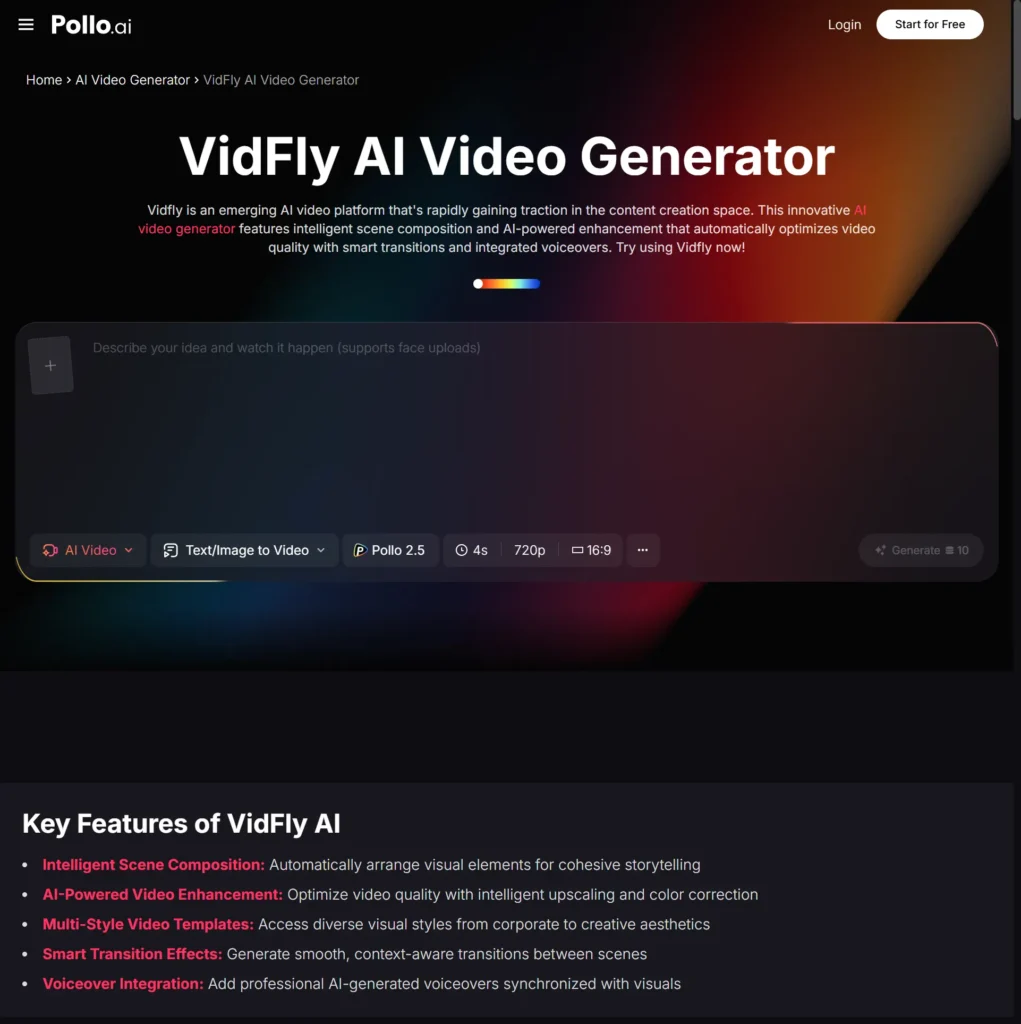
The AI video landscape is maturing, and different platforms are carving out distinct niches. Vidfly AI, for instance, has made a name for itself by turning e-commerce product URLs into short video ads with minimal manual effort. It’s a focused tool built for marketplace sellers and dropshippers who prioritize speed and volume over creative nuance. For a dropshipper testing fifty products a week, the ability to generate a passable video ad for each product in seconds is far more valuable than having granular control over every frame.
Pollo AI serves a broader creative need. Where Vidfly AI excels at rapid, template-driven ad creation for product catalogs, Pollo AI offers more flexibility for creators who need AI avatars, multi-scene narratives, and brand-consistent output that extends beyond short ad formats. The platform consolidates multiple AI video tools — text-to-video, image-to-video, avatar-based generation — into a single ecosystem, which means creators can handle different content types without juggling multiple subscriptions and learning curves.
The ecosystem is maturing in a way that benefits everyone. Rather than one tool trying to do everything, platforms are specializing, and the smartest creators are building toolkits that combine different strengths for different stages of their workflow. Understanding where each tool fits is more valuable than declaring any single one “the best.”
Practical Tips for Getting the Most From AI Video Tools
Knowing that these tools exist is one thing. Using them effectively is another. A few habits separate creators who get mediocre results from those who consistently produce content that performs.
Write better scripts. The single biggest lever you have over output quality is the input. AI video makers are only as good as the script you feed them. Spend time crafting clear, conversational copy before you touch any generation tool. Read it aloud. If it sounds stiff when spoken, it will sound stiff coming from an AI avatar too.
Match the tool to the task. Don’t use a full-featured AI video maker when a simple product ad generator would be faster, and don’t try to squeeze a complex narrative out of a tool designed for thirty-second clips. Being intentional about which tool you reach for saves time and produces better results.
Iterate quickly. Generate multiple versions, compare them, and pick the strongest. AI generation is fast enough that producing three variations of a segment costs you minutes, not hours. That review process is where your creative judgment adds the most value — the AI handles execution, and you handle taste.
Also Read: CAGR vs XIRR: Which Return Calculator Gives the Real Picture?
Building a Sustainable Content Engine
The long-term play isn’t about replacing human creativity. It’s about removing the repetitive production tasks that consume time without adding creative value. Creators who build systems around AI video makers find that they spend more time on ideas, scripting, and strategy — and less time on the mechanics of recording and editing.
That shift in time allocation is where the real competitive advantage lives. The creators who thrive over the next few years won’t be the ones who resist AI tools or the ones who rely on them blindly. They’ll be the ones who learn to use AI for what it does well — speed, consistency, scale — while investing their freed-up time in the things AI still can’t do: original thinking, authentic perspective, and the kind of creative instinct that turns a good idea into something people actually want to watch.