Introduction
In heavy-duty machinery, worm gearbox failures—overheating, noise, wear, or loss of self-locking—cause costly downtime. While often seen as maintenance issues, up to 80% stem from a deeper, design-phase problem: a lack of systematic balance between gear ratio, material pairing, and thermal management. True reliability requires moving beyond treating it as a standard part. It must be engineered as a synergistic system integrating tribology, thermodynamics, and structural mechanics. This article explores a systematic worm gear engineering framework to transform development from trial-and-error into a predictable, high-reliability discipline.
The Iron Triangle of Worm Gear Design: How to Balance Ratio, Efficiency, and Self-Locking Without Compromise?
At the heart of worm gear design lies a fundamental, interlocking constraint: the CNC precision turning of reduction ratio, mechanical efficiency, and self-locking reliability. These three parameters are inextricably linked; aggressively pushing one corner invariably compromises the others. A high reduction ratio, desirable for torque multiplication, typically requires a lower lead angle, which reduces efficiency and increases frictional heat generation. Conversely, excessively prioritizing self-locking by specifying an overly small lead angle can introduce manufacturing difficulties and increase the risk of jamming or high breakout torque.
The solution is to move beyond static selection based on peak torque. A robust design process involves dynamic calculation based on the actual duty cycle and thermal operating environment. This requires analyzing the load spectrum—not just the maximum load but also the duration, frequency, and sequence of loads—to properly size the gear set for thermal capacity and long-term wear life, not just momentary strength. Authoritative mechanical design principles, such as those outlined by the American Society of Mechanical Engineers (ASME), underscore that sustainable design is about balancing system parameters for the intended service life.
Mastering this balance is not a trivial task. It demands a deep understanding of the interactions between geometry, friction, and heat dissipation. To fully grasp the engineering nuances and practical case studies behind this systematic trade-off, the in-depth guide on worm gear manufacturing provides a complete pathway from theory to application.
Beyond Hard Steel, Soft Bronze: How Does Material Science Dictate a 4X Service Life?
Engineering the Worm: From Core to Surface
Core Material and Heat Treatment
The worm is not merely “hard.” For high-load applications, it is fabricated from a case-hardening steel like AISI 8620. A controlled atmosphere carburizing process creates a deep, hard case (HRC 58+) on the tooth flanks for wear resistance, while maintaining a tough, ductile core to absorb shock loads and prevent brittle fracture.
l Advanced Surface Engineering
Machining aluminum parts treatments like ion nitriding form a thin, ultra-hard, and low-friction surface layer on the worm. This further optimizes the tribological pair, reducing the coefficient of friction, mitigating adhesive wear, and enhancing resistance to scuffing for greater durability.
Selecting the Optimal Worm Wheel Material
Tin bronze (e.g., C93200) is typical, but it may not be sufficient for severe working conditions that have abrasives or are at elevated temperatures. Aluminum bronze (e.g., C95400) is a step up in terms of wear resistance, strength, and it also has better corrosion resistance so that it becomes the high torque worm gear material of choice for harsh conditions in mining, steel, or heavy conveyor applications. Information from sources such as the ASM International Handbook gives the scientific basis for choosing a material pair that is deliberately engineered to work together for the particular operating environment.
Is Sub-Micron Accuracy on a Worm Shaft Just About a Good Grinder?
Achieving and, more importantly, consistently replicating sub-micron accuracy in worm shafts is a question of process control, not merely machine ownership. Possessing a state-of-the-art worm grinding machine is necessary but insufficient. True precision in precision worm gear machining is the result of a closed-loop, digitally controlled process.
This process encompasses several critical stages: diamond roll dressing to ensure perfect grinding wheel profile, in-process measurement and thermal compensation to counteract machine and part deformation, and final verification on a gear measuring center. The latter generates a complete tooth flank topography map—a digital “fingerprint” of the part. This map confirms that the actual micro-geometry (lead, profile, pitch) aligns with the design intent, which directly dictates performance parameters like efficiency, smoothness, and noise generation. This level of control ensures predictable performance in the field.
Therefore, marrying this level of closed-loop process control with rapid design iteration requires a partnership with a manufacturer capable of close, real-time engineering collaboration. For many OEMs, finding a responsive and deeply technical custom gear manufacturer near me becomes a strategic advantage, enabling faster problem-solving and design optimization.
The Contact Pattern Doesn’t Lie: How to Use It as Your Final Assembly Diagnostic.
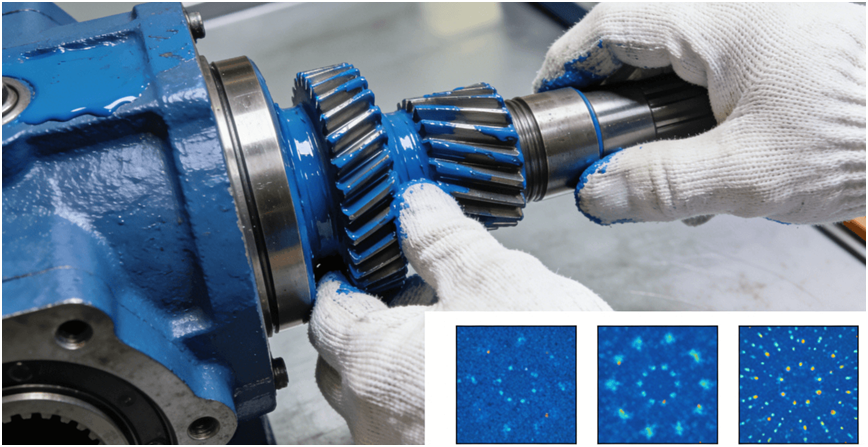
The most critical and telling validation of a well-designed and well-made worm gear set occurs not on a CMM report, but during final assembly: the contact pattern test. This simple yet profound diagnostic involves applying a thin layer of engineer’s blue (prussian blue) to the worm wheel teeth, briefly rotating the assembly under light load, and then inspecting the resulting transfer pattern on the worm threads.
An ideal pattern is centered on the worm thread flank, covers more than 60-70% of the active area, and indicates perfect alignment. Specific faulty patterns are diagnostic: contact at the tip or root suggests center distance errors, while diagonal contact indicates non-perpendicularity (axis error) between the worm and wheel shafts. These misalignments are primary drivers of localized stress, excessive heat, noise, and accelerated wear. In advanced worm gearbox manufacturing, especially for critical applications, this test is non-negotiable.
Adherence to stringent quality management systems institutionalizes this practice. For instance, a manufacturing system following IATF 16949 standards requires a Production Part Approval Process (PPAP) where contact pattern reports are mandatory deliverables, providing systematic assurance of batch-to-batch consistency for Industrial Gears.
From 5 Prototypes to 500 Gearboxes: How to Ensure Your Pilot Run Doesn’t Become a Field Trial?
Locking Down the Process: From Prototype Parameters to Production Protocol
The true risk in scaling from prototypes to a pilot run is the discontinuity of critical knowledge. A provider of genuine worm gear solutions prevents this by institutionalizing the prototype’s success through rigorous process locking and documentation.
l Documenting and Freezing Manufacturing Parameters
All optimized parameters from prototyping—including precise cutting speeds and feeds, exact heat treatment temperature curves, and cycle times—must be meticulously documented. This recipe is then formally frozen and issued as the sole standard for the pilot production run, ensuring repeatability.
l Standardizing Assembly and Adjustment
Key assembly adjustments, such as the specific shim packs required to achieve precise backlash, are recorded and standardized. This turns a skilled bench operation into a controlled, repeatable production process, guaranteeing every unit matches the prototype’s performance.
Ensuring External and Verification Consistency
Consistency extends beyond internal manufacturing. It requires solidifying the external supply chain and applying an unchangeable verification standard to guarantee that pilot-run units are materially and functionally identical to the validated prototypes.
This involves formally approving and listing the specific sub-suppliers (for bearings, seals, lubricants) qualified during prototype testing. Furthermore, the identical performance test rig, procedures, and acceptance criteria used to sign off on the prototypes must be applied to statistically sampled parts from the pilot batch. This approach, supported by manufacturing knowledge management principles from organizations like the Society of Manufacturing Engineers (SME), de-risks the launch of Custom Gear Solutions by transforming the pilot from a field trial into a predictable scale-up.
Conclusion
In demanding power transmission applications, the worm gear drive has evolved from a simple component purchase into a deep engineering discipline requiring the fusion of mechanical design, materials science, precision manufacturing, and systemic validation. By adopting the Systematic Worm Gear Engineering framework outlined here, and partnering with a manufacturer possessing the vertical integration capabilities, data transparency, and quality certifications to execute it, design engineers can transform the high-torque right-angle drive. It ceases to be a potential failure point and maintenance burden, and instead becomes a cornerstone of long-term equipment reliability and efficiency.
Submit your drive application requirements or existing worm gearbox drawings today to receive a complimentary preliminary analysis report on Potential Risks and Optimization Points for High-Torque Drive Reliability.
H2:About the Author
This article reflects extensive experience in the design and production of high, torque precision drive systems. CNC Protolabs, a manufacturing partner certified to ISO 9001, IATF 16949, and AS9100D, is committed to resolving the most complicated transmission problems through complete, process collaboration from the very first system design review to ensuring batch production consistency.
H2:FAQs
Q: What is a realistic lead time for a custom worm gear pair from design to prototype?
A: For a new design requiring engineering analysis, machining, heat treatment, and testing, a lead time of 6-8 weeks for functional prototypes is typical. This includes time for potential design refinements based on initial DFM feedback. Subsequent batches or production orders have shorter lead times.
Q: How do you ensure the self-locking function is absolutely reliable, especially under vibration?
A: Reliability is engineered through design and verification. The lead angle is designed 1°-2° below the dynamic friction angle of the material pair. This is then physically validated on a test rig that applies reverse torque and shock loads. We also control surface finish to ensure a stable, predictable coefficient of friction.
Q: What is the highest precision grade (e.g., DIN standard) achievable for worm gears?
A: Through grinding and hard skiving processes, we consistently achieve DIN 5-6 accuracy for high-performance industrial applications. For the most critical aerospace or defense applications, DIN 3-4 levels are possible. The appropriate grade is recommended based on your specific performance needs versus cost trade-offs.
Q: Can you provide a complete gearbox assembly, not just the gears?
A: Absolutely, we provide turnkey solutions. Besides the gears, we can handle the housing design/ manufacturing, bearing selection, lubrication system integration, and full assembly with run, in testing. This guarantees the best performance of the whole system and a ready, to, install unit is delivered.
Q: How do we start a project and get a meaningful quote without detailed drawings?
A: You can give a start by specifying the main performance parameters such as input speed, output torque, reduction ratio, duty cycle, and operating environment. Based on this, we are able to carry out a feasibility study and come up with a preliminary technical proposal and budget estimate. The detailed quotation will be made once the conceptual design is fixed.