Introduction
In today’s competitive market, product development teams and procurement engineers face a common problem: pay a high premium to achieve rapid delivery or wait long production cycles to save costs. Communication challenges and unclear quoting mechanisms in traditional manufacturing processes only make project timelines and budget risks more complicated. The underlying reason for this problem, however, is that traditional supply chains are inherently inefficient and lack transparency. Each step of the process, from initial inquiry to production, creates a possible delay and uncertainty, making it very difficult to plan a project.
This article will explore the concept of professional online CNC Machining Services, including how it helps to achieve acceleration and cost reduction in manufacturing while maintaining precision quality. So, what’s the magic behind online CNC turning services? The answer to that question can be broken down into five important areas.
How to choose a reliable online CNC turning service to ensure part quality?
Selecting a partner for CNC turning services requires a careful evaluation of several core competencies to guarantee the quality of the final components.
Technical and Equipment Capabilities
The starting point of quality is advanced technology. A quality service provider is one that has the latest technology, such as multi-axis turning centers, which help in the manufacture of complex shapes with precision. Another important factor is the expertise of the technical staff who are capable of programming the process in order to handle different types of materials.
Systematic Quality Assurance
Quality is not something that occurs by chance. Reliable service providers are typically ones that have quality certification, which is a measure of their professionalism and a guarantee of a system that is capable of producing quality products such as CNC Precision Turning
l General Quality Management
ISO 9001 certifications show that there is a standard quality management system in place for all processes, including design, production, and service.
l Industry-Specific Certifications
In high-quality industries like the automotive industry, which requires reliability, traceability, and safety, industry-specific certifications like IATF 16949 or AS9100D show that the quality management system is up to high standards.
Digital Transparency and Value Assessment
Professional online manufacturing platforms use instant quoting systems to create transparency about price and manufacturability analysis, which is usually lacking in traditional methods. One common mistake to avoid is choosing the manufacturing partner solely on the basis of price. The cost associated with compromised quality, lack of technical support, and an unreliable supply chain is usually much higher in the long term compared to the cost savings. A comprehensive platform like the CNC turning services offered by JS Precision is an example of an integrated approach to manufacturing.
Where are the key quality control points for precision turned components?
The manufacture of precision turned components of high standard is a process where quality control plays a pivotal role at various steps. The basic parameters of the process, such as cutting speed, feed rate, and tool material, have a direct effect on the surface finish, accuracy, and geometric tolerance of CNC Precision Turning Parts. A slight deviation in these parameters can cause problems such as chatter marks, burrs, or dimensional errors.
The problem is more acute in the precision turning of steel components. Various types of steel (free-cutting steel, alloy steel, and stainless steel) require different tool materials, cooling systems, and cutting parameters based on differences in hardness, thermal conductivity, and work hardening properties. For example, turning stainless steel requires efficient heat removal to avoid deformation of the material and prolong tool life.
Precision inspection is the quality watchdog. Sophisticated inspection tools such as Coordinate Measuring Machines (CMMs) and optical comparators are necessary for inspecting components against CAD designs to check micron-level accuracy. Data-driven inspection, along with Statistical Process Control (SPC) techniques recommended by recognized institutions such as the Society of Manufacturing Engineers (SME), plays a vital role in maintaining consistency in batch production.
How does the CNC turning process adapt to the entire workflow from prototyping to mass production?
The CNC turning process is exceptionally well-suited to the entire product lifecycle, from concept to market, owing to its flexibility and consistency.
From Digital Design to Physical Prototype and Beyond
A basic CNC turning process begins with a CAD file, which is converted to machine instructions with the help of CAM software. This digital nature makes it an ideal tool for the iterative philosophy that any Rapid Prototyping Guide advocates, allowing designers to create physical prototypes in mere days. The process continues to a detailed engineering phase where professional teams analyze and optimize it further.
l Design for Manufacturability (DFM) Analysis
In this phase, professional engineering teams undertake Design for Manufacturability (DFM) analysis, offering suggestions to further improve the product’s strength, simplify it, or even make it less expensive. For instance, even a small change to a design for CNC Precision Turning Parts could result in considerable time savings or even eliminate the need to create special tools.
l Access to Technical Expertise and Case Studies
Readers can explore specific technical details and real-world machining cases by reviewing this resource on CNC Precision Turning Parts, which provides deep insights into the application of these principles.
Seamless Scaling for Volume Production
After the prototype has been validated, the benefits of custom CNC turning services will become even more clear. With validated programs, optimized fixtures, and optimized processes, suppliers can scale production from a prototype to hundreds or thousands of units. This seamless scaling ensures quality throughout the life cycle of the product without having to go through the qualification process again with a new supplier.
How does the online on-demand production model reduce costs and increase efficiency for enterprises?
The on-demand part production model, enabled by advanced online manufacturing solutions, fundamentally reshapes corporate supply chains and cost structures. Primarily, it drastically reduces inventory carrying costs and capital investment risks. Companies no longer need to stockpile parts for forecasted demand, converting “inventory” into “in-transit goods” and freeing up significant cash flow.
Secondly, online manufacturing platforms streamline the traditionally lengthy and inefficient multi-step process (finding suppliers, requesting quotes, technical communication, order tracking) into a few simple steps for the user. Uploading drawings, receiving instant quotes, placing orders online, and tracking production progress—this digital workflow drastically reduces communication costs and human error, allowing procurement staff to focus on more strategic tasks.
According to reports from industry associations like the European Committee for the Co-operation of the Machine Tool Industries (CECIMO) on digital trends, this integrated and transparent supply chain is the future of manufacturing. A typical case study might show how a company consolidated its R&D department’s scattered part requests through an online platform. By leveraging the platform’s process optimization algorithms and bulk purchasing power, the company achieved an overall procurement cost reduction of approximately 30% while maintaining quality, and simultaneously reduced the average lead time by 40%, truly achieving the dual goal of cost reduction and efficiency improvement.
What solutions does multi-axis CNC turning technology offer for complex parts?
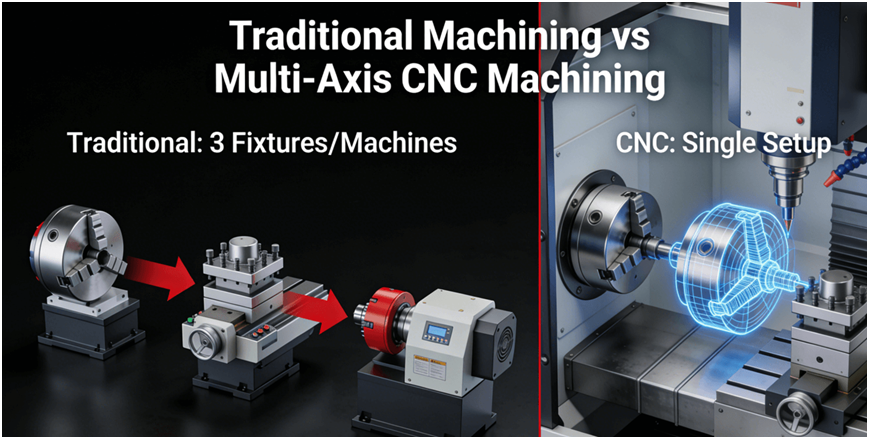
For complex geometries, conventional turning methods are not sufficient, and multi-axis CNC turning technology offers a revolutionary solution. Machines equipped with five-axis simultaneous movement capability enable turning, milling, drilling, and tapping operations in a single setup.
This complete-in-one-setup approach is a decisive advantage for machining complex precision turned components such as eccentric shafts or parts with complex contours. It not only eliminates the datum errors associated with multiple setups, ensuring extremely high geometric tolerances (like concentricity and perpendicularity), but also enables the production of single, integrated complex parts that would previously require multiple assemblies, thereby enhancing overall product strength and reliability.
Consequently, multi-axis technology significantly expands the capabilities of CNC Machining Services. It highly integrates what was once a lengthy, discrete CNC turning process, simplifying the workflow, shortening the total production cycle, and markedly reducing the cost and quality risks associated with process changeovers. It is a core technology in high-end precision manufacturing.
Conclusion
In a nutshell, it can be said that through the selection of online manufacturing services that possess superior technical capabilities and quality systems, it is possible to achieve full optimization in terms of speed, cost, and quality in the manufacturing of precision parts. By utilizing efficient digital platforms and superior CNC turning technology, it is definitely possible to achieve this goal. This not only helps to address current market challenges but is a significant step towards future intelligent manufacturing.
If you are looking to achieve a faster, more cost-effective, and efficient solution to your precision turned part needs for a critical project, it is highly advisable to upload your part drawings to a reputable online platform today and obtain an instant quote and manufacturability analysis to get started with optimizing your supply chain.
FAQ Section
Q1: What is the general lead time for online CNC turning services?
A1: Generally speaking, the lead time will vary depending on the complexity of the part and the quantity of the parts to be produced. For moderately complex parts in standard materials, professional online CNC turning service providers can normally provide prototypes within a 3-7 day time frame and production within a 10-15 day time frame.
Q2: How is the dimensional accuracy of the turned parts, ordered online, ensured?
A2: Professional online CNC turning service providers will normally provide detailed quality inspection reports, often via Coordinate Measuring Machines (CMMs). It is important that the accuracy of the parts be specified in the online inquiry and that the inspection capabilities of the supplier match the specified tolerance ranges.
Q3: Do online platforms support CNC turning of various special materials?
A3: Yes, there are dozens of metal and engineering plastic materials available on the online platforms, ranging from stainless steel, aluminum, to PEEK, titanium, etc. The online platforms’ material libraries will normally provide information on the properties and application scenarios of the various materials for the user to select from.
Q4: How are situations usually dealt with if the received parts do not live up to expectations?
A4: Formal service providers have proper procedures for resolving quality disputes. As soon as a non-conformity is identified, communication with supporting inspection data should be started right away. Suppliers with certifications such as AS9100D usually have proper corrective and preventive action procedures to safeguard the rights of clients.
Q5: Is this model appropriate for low-volume, high-mix R&D requirements?
A5: It is very appropriate. One of the major benefits of the online on-demand production model is its flexibility in dealing with low-volume, high-variety production. It substantially lowers the startup cost per part, making it very appropriate for the R&D stage.